Highlights
- The sacred rats are known locally as kabas or kabbas.
- White rats hold special significance in local belief.
- The temple is in Deshnok near Bikaner, Rajasthan.
Incredible India describes thousands of rats living in the temple and identifies their local name as kabbas, also written kabas. They are treated as sacred beings rather than unwanted intruders.
The question worth asking is therefore not simply “Why are there rats inside?” It is “What relationship do worshippers see between these animals, Karni Mata and their own community?” That moves the story beyond a surprising photograph.
A visit need not begin with knowing every ritual. It can begin with recognising that the animal crossing your path has a different meaning here from the one you might bring from home.
The belief behind their protected place
The Ministry of Tourism’s account connects the rats with a sacred narrative about Karni Mata, a lost son and Yama, the god of death. In the version it presents, a promise links her community’s souls with rebirth as rats and, later, as humans.
This is a religious narrative about death, return and belonging—not a biological explanation or an independently established historical event. Local tellings vary; a short travel guide should not pretend to settle every version.
Seen through that tradition, protecting the animals is more than tolerating them. It is an expression of a relationship. That is the part of the story that an image of a crowded feeding dish cannot explain on its own.
Why a white rat draws special attention
Rajasthan Tourism describes a special reverence for white rats, associated in local belief with Karni Mata and her sons. A sighting may carry devotional significance for worshippers.
It is not something a visitor can book or demand. Our advice: observe quietly and give the animal space. Do not chase it, block its path or disturb worshippers to produce a particular photograph. The meaning of a sighting does not require turning it into a performance for a camera.
The same restraint makes the story better to share: explain the belief behind the attention, rather than presenting a white rat as proof of a guaranteed personal blessing.
The detail worth telling a friend
The striking part is not only that rats live in a temple. It is that understanding a belief can change an animal’s place in a human community—from something avoided to something carefully protected.
If you send this story to a friend, share the reason alongside the surprise. Karni Mata Temple is a place of worship with a living tradition, not just a setting for an unusual travel photograph.
For another tradition that rewards looking beyond first impressions, read why devotees adopt Kali and other guises at Kulasai Dasara. For a different meeting of nature and devotion, explore Stambheshwar Mahadev and the changing tide.
Planning your visit
Deshnok, not the similarly named temple in Udaipur
Rajasthan Tourism places this Karni Mata temple in Deshnok, about 30 km from Bikaner. The destination matters: do not book transport to another Karni Mata shrine on the strength of the name alone.
For a Bikaner-based visit, save the complete destination name, ask your accommodation to confirm the drop-off and arrange the return as well as the outward ride. Ask what the quote includes, how long the driver will wait and where you will meet afterwards. We have not verified a current taxi fare or a fixed journey time.
If using rail, check your actual arrival station and service for your date through IRCTC. A reference to a destination in an itinerary does not establish that a particular train stops there today. Keep onward reservations far enough apart to allow for the visit and the return transfer.
A first visit: curiosity with consideration
- Watch your path. Move slowly and leave space for animals and people. Do not step into an animal’s path to stage a photograph.
- Ask before photographing. Permission to enter does not establish permission to photograph the sanctum, rituals or individual worshippers.
- Check the local practice. Ask staff about footwear, belongings and offerings before joining a ritual or bringing food for the animals.
- Be clear about participation. Observing, making an offering and participating in a ritual are different choices. Ask what is appropriate rather than copying a gesture you do not understand.
- Discuss access needs. Ask about steps, the route from the drop-off, crowd conditions, resting places and companion assistance. This guide does not certify a step-free visit.
- Confirm personal eligibility. The reviewed tourism descriptions do not establish access to every area for every nationality or religious background. Ask about the areas you intend to visit.
These are RouteTales’ planning suggestions. You can explain what a custom means without treating participation as a requirement for every reader.
Your quick reference
At a glance
- Destination
- Karni Mata Temple, Deshnok, near Bikaner, Rajasthan
- Central curiosity
- Why the resident rats are considered sacred
- Local name
- Kabas / kabbas
- White rats
- Special reverence in local belief; no promised sighting
- Published regular hours
- 4 am–10 pm IST; reconfirm for your date
- Ordinary admission
- Listed as free by Rajasthan Tourism; separate services may differ
- Navratri
- Fairs described twice yearly; exact October 2026 programme unverified
Common questions
Frequently asked questions
Why are rats sacred at Karni Mata Temple?
A local religious narrative links Karni Mata’s community, rebirth and the protected animals. The story is presented as belief, not independently verified history.
What are the temple rats called?
Kabas, also written kabbas. Understanding their sacred place in the tradition explains why visitors are asked to treat them with care.
Can I arrange to see a white rat?
No sighting is guaranteed. Observe quietly and never disturb an animal or worshippers to obtain a photograph.
Is this the Karni Mata temple in Udaipur?
No. This guide concerns the temple at Deshnok near Bikaner. Check the complete destination name before booking transport.
What are the opening hours and entry fee?
Rajasthan Tourism publishes 4 am–10 pm IST and free ordinary admission. Reconfirm current arrangements and distinguish admission from private services.
Are the exact October 2026 fair dates confirmed here?
No. The reviewed source describes the recurring Navratri fairs, but a complete dated 2026 temple programme has not been verified.
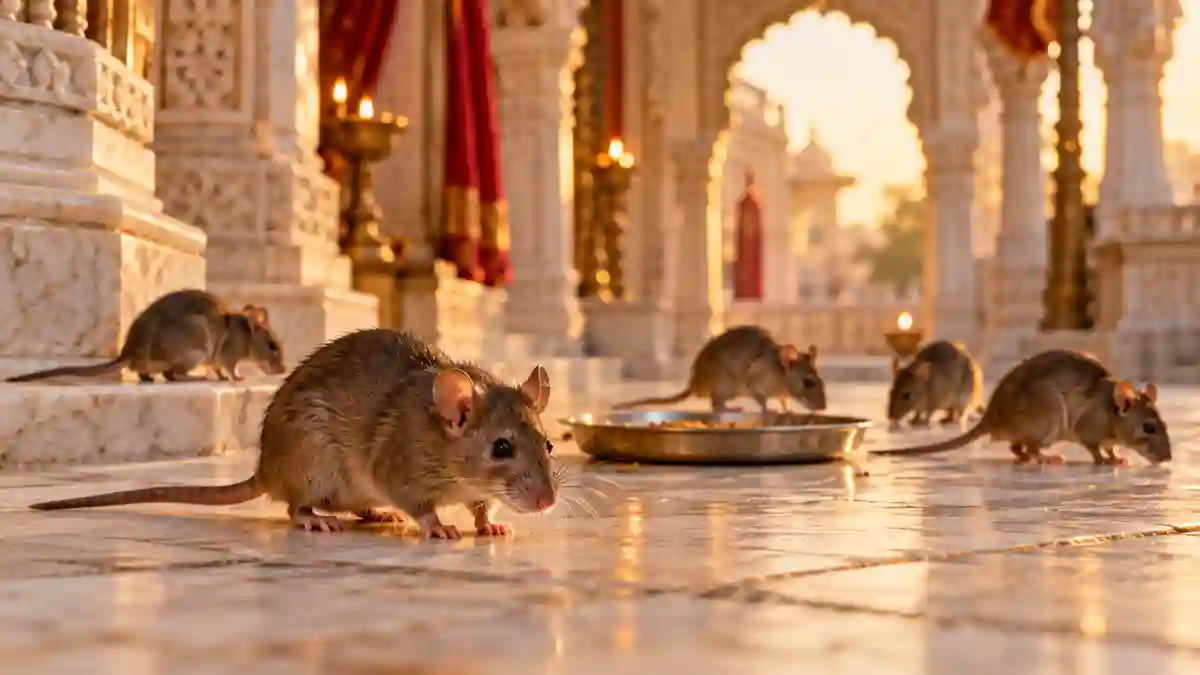
Is the hero image a real photograph?
No. It is an AI-generated conceptual illustration of fictional animals and architecture, clearly labelled in its caption.
Official sources & final checks
Sources reviewed on . Prices, timings and access rules can change. Confirm your date and service with the operator; this page does not show live availability.
- Incredible India, Ministry of Tourism: sacred kabas and the religious narrative ↗
- Rajasthan Tourism: Deshnok location, white-rat belief, regular hours and admission ↗
- Ministry of Tourism Utsav listing: recurring Navratri fairs; indexed description read, dated event is 2024 ↗
- IRCTC: check trains and the actual arrival station for your travel date ↗